
Individual Giving in Scotland: donations, legacies and fundraising
Individual Giving in Scotland 2026
Charitable giving by the general public in Scotland
About
This page pulls together key facts about the individual giving landscape in Scotland and the wider UK using a range of data sources including the Scottish Third Sector Tracker. Individual giving is an essential source of income for many charities and voluntary groups and helps fund an enormous range of activities. Here we highlight some headline figures, with a focus on key trends in recent years both during and after COVID-19.
We hope the information on current trends in donations and fundraising will provide useful benchmarking info for boards, managers, and community fundraisers, helping place the impact of current giving and campaigns in the wider picture.
Key insights: donations, legacies and fundraising
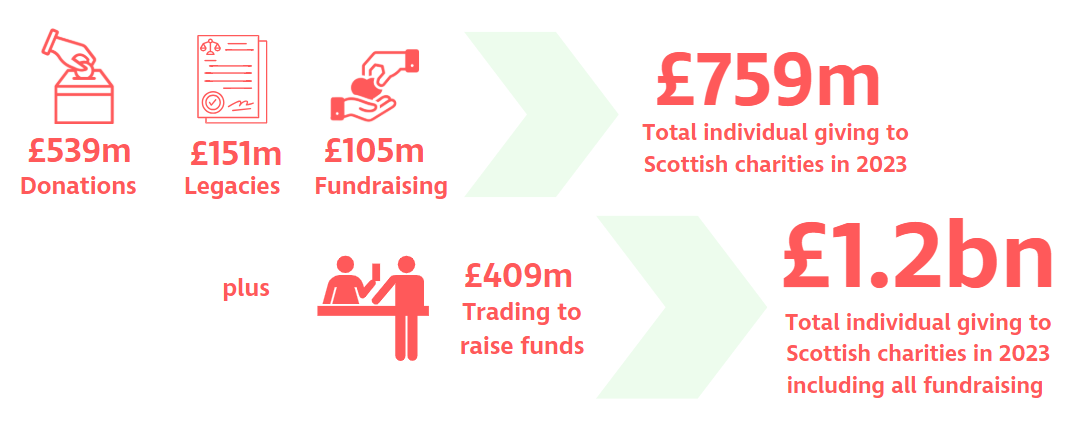
- Individual giving from the general public was worth an estimated £1.2bn to Scottish charities in 2023.
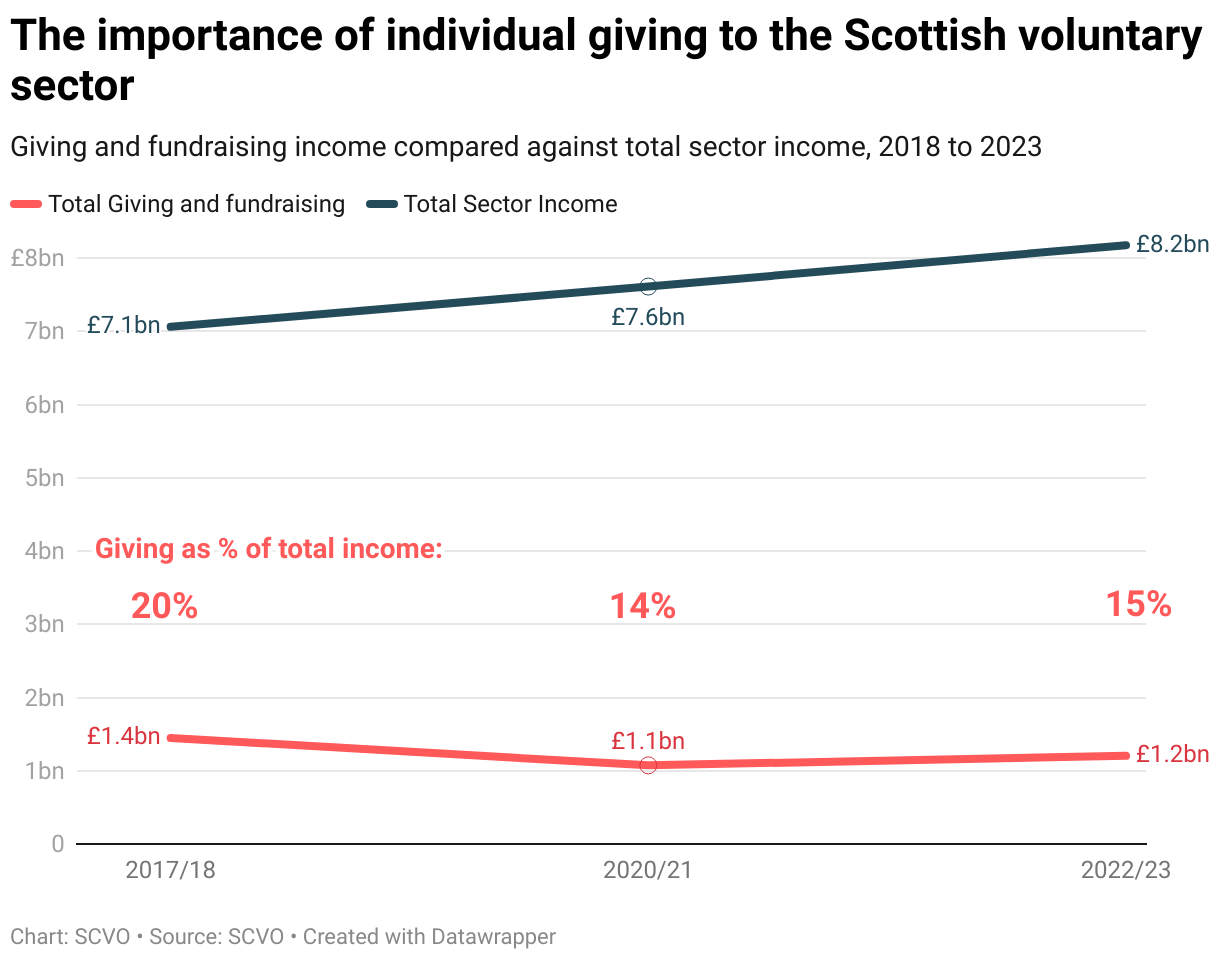
- Income from individual giving made up 15% of the Scottish charity sector’s income in 2023, down from around 20% in 2018 and previous years.
- Income from individual giving has fallen in real terms by over £240m in recent years, from £1.45bn in 2018 to £1.2bn in 2023.
- Most income streams from the general public were hit hard by Covid, and while many of these income streams have now bounced back they have generally not recovered to pre-pandemic levels.
- Donations are the main factor driving the downturn in individual giving - donations fell in real terms by £224m between 2018 and 2023, a drop of 30%.
- Fewer individuals are donating to charity, although many who do donate are giving larger amounts.
- Data from the Spring 2025 Scottish Third Sector Tracker suggests that a rising number of voluntary organisations saw positive growth in both donations and fundraising income, suggesting some reasons for cautious optimism despite the challenging financial environment.
- However, CAF reports a reduction in both the number of UK donors and the average value of donations, resulting in a decrease in total UK giving.
- According to CAF's UK Local Giving Report 2026 Scottish people donated an estimated £910m to charities in 2025, down from an estimated £1.1bn in 2024.
Methodology and key data sources
Data sources
These pages pull together what we know about:
1. The amount of income that the Scottish voluntary sector receives from the general public via donations and fundraising.
This data is based on latest SCVO Sector Stats and our analysis of over 600 charity accounts for the financial year ending 2023. For more on the sampling frame and data weighting used see our Sector Stats Methodology.
Where figures have been adjusted for inflation we have used the appropriate GDP deflators and will have stated this.
Note that the sector income data relates only to income received by charities - many Scottish voluntary organisations not registered as charities also receive money from donations etc, but there is no official data available. The value of this is likely to be very low given the small size of most non-charitable voluntary groups.
2. Current donation and fundraising income trends, as reported by organisations.
Current donation and fundraising trends are based on a range of sources including intelligence from the Scottish Third Sector Tracker, a panel survey of hundreds of Scottish charities running since 2021.
3. Current donor trends, as reported by donors themselves.
Donor figures and trends are based primarily on CAF's UK Giving Report 2025 and their UK Local Giving Report 2025. The 2025 CAF findings are based on responses from 13,459 individuals across the UK including a large Scottish sample.
Definitions
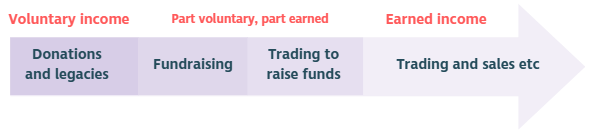
This briefing follows the conventions for classifying income typically used in charity accounts, where Donations tend to be given with nothing expected in return, while Fundraising tends to reflect a small transactional element - they can be viewed as as sitting on different parts of a spectrum ranging from totally voluntary income to totally earned income:
‘Donations' typically includes cash donations, collection tins, donations of goods, direct debits, payroll giving, online giving, and membership fees where no goods or services are received in return. Legacies are also purely voluntary donations.
Fundraised income
Income from fundraising and trading to raise funds sits somewhere between purely voluntary income and purely earned income - they have a transactional element, but usually not at a conventional commercial level. They are not earned via a charity's primary purpose or via a subsidiary company (which would be categorized as Contract income or Sales and Trading income).
Fundraising is typically the term used in the receipts and payments accounts of smaller charities, while larger charities use the term Trading to raise funds as per the SORP accounting framework - see OSCR's charity accounting info.
‘Fundraising’ here includes fundraising events (quizzes, charity balls, coffee mornings), fundraising ‘non-commercial’ sales eg bake sales, raffles, membership fees where people receive something meaningful in return eg discounted or free access to facilities, regular magazines etc. However, some types of income that are often categorised as 'fundraising' in charity accounts could be viewed as pure donations, for example sponsorship monies, or cash donations received at community fundraising events.
'Trading to raise funds' includes income from charity shops and goods sold online, and can also include money from charitable lotteries.
The distinction between donated income and fundraised income can be quite blurred, and to what extent a member of the public is expecting 'something' in return for their money can be quite subjective.
The SCVO figures in the following sections are based on analysis of charity accounts and therefore reflect how charities themselves have categorized income sources in their accounts.
How much money does the Scottish voluntary sector get from individual giving?
- Scottish charities received an estimated £1.2 billion from individual giving in 2023, including Donations (£539m), Legacies (£151m), Fundraising (£105m) and Trading to raise funds (£409).
- This is higher than the £1.05bn (£1.1bn when adjusted for inflation) received via individual giving in 2021.
- However, it is £37m lower than the £1.24bn the sector received via individual giving in 2018, and when we adjust for inflation we see a fall in real terms of £244m, from £1.45bn in 2018 to £1.2bn in 2023.
-
Income from individual giving: recent trends
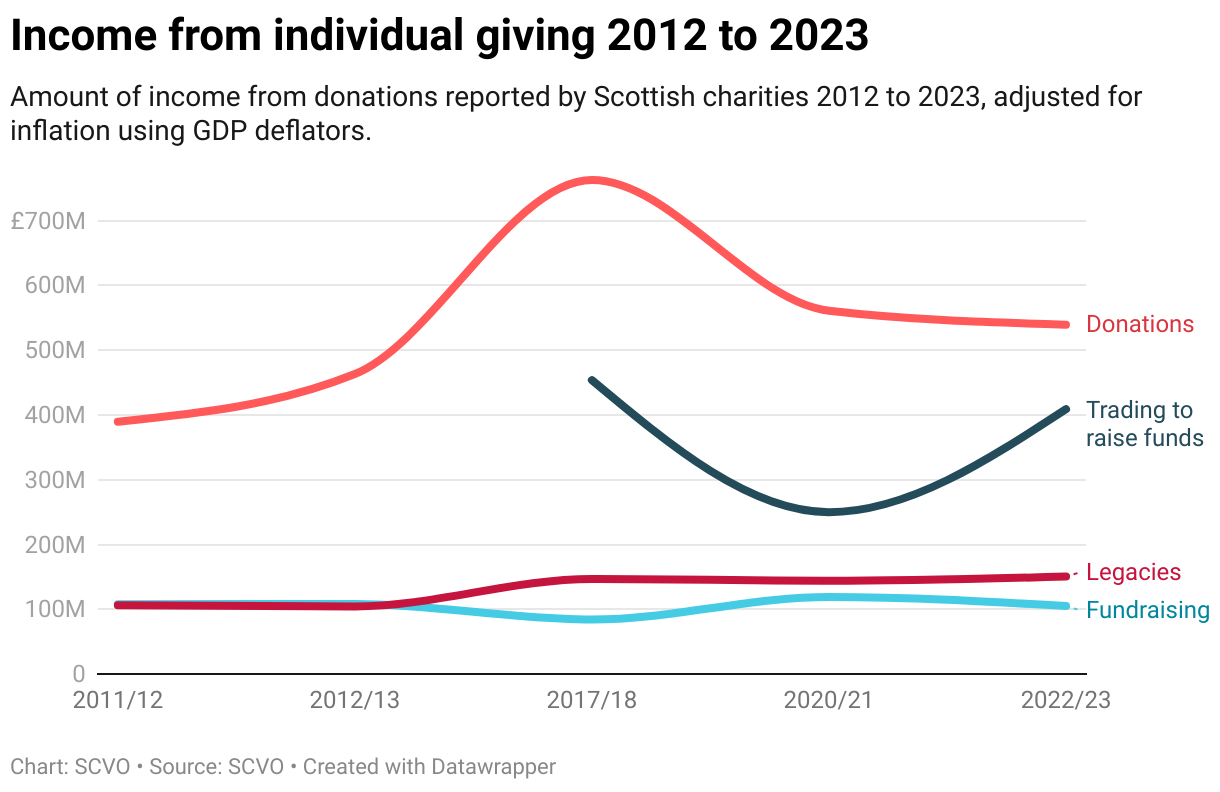
- After peaking in 2018 we can see a large dip in donations in 2021 in the chart below. This reflects Covid and the cost of living crisis and high inflation levels seen just after the pandemic. Despite investment in online giving etc donations have not bounced back in the way that trading to raise funds was able to - we look at this in more detail in the Donations section below.
- We saw a large dip in income from 'trading to raise funds' in 2020/21 during Covid, as charity shops etc closed doors, and fewer in-person fundraising activities took place. This now appears to be recovering but has not yet recovered to 2018 levels - we look at this in more detail in the Fundraising and Trading to raise funds section below.
-
The importance of individual giving to the Scottish voluntary sector
- Individual giving made up 15% of the sector's income in 2023 - this is down from 20% in 2018.
Donations and fundraising are an essential source of income for most voluntary organisations, but we have seen the relative importance of individual giving decrease slightly in recent years, primarily due to the growth of other income sources.
-
Individual giving: variations by organisation size
- Some charities rely entirely on donations to fund their work, while others receive no money from individual giving. Most sit somewhere in between.
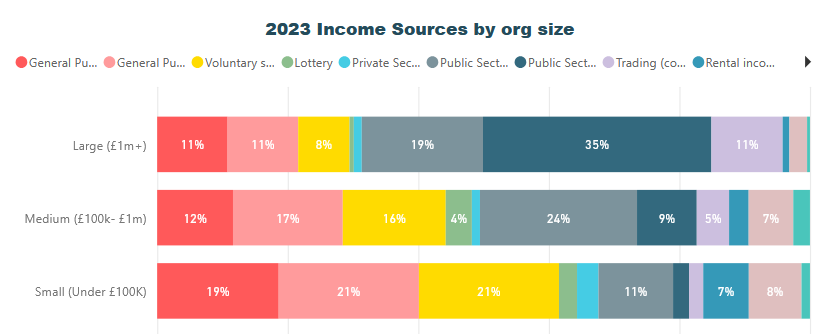
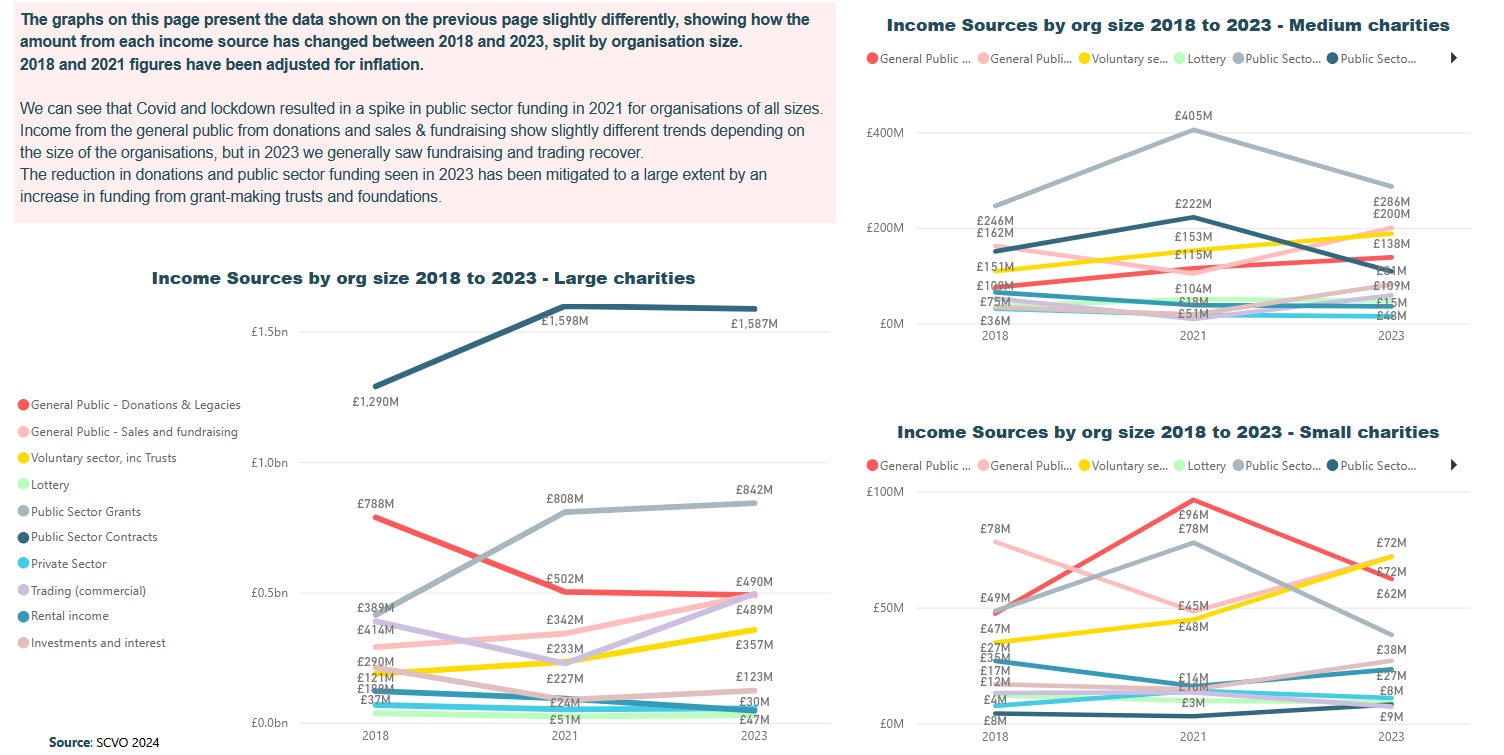
- The relative importance of individual giving can also vary depending on organisation size - for example, donations made up almost 20% of the collective income of small charities in 2023, but only around 10% of the income of larger charities.
- We also saw individual giving streams display slightly different trends depending on the size of organisations particularly during Covid, possibly reflecting the different ways in which charities operated during the pandemic and the different fundraising strategies they were able to implement.
- For more on income sources and trends and breakdowns by organisation size such as the graphs below see p7-9 of our latest Sector Stats.
Donations
Income from donations
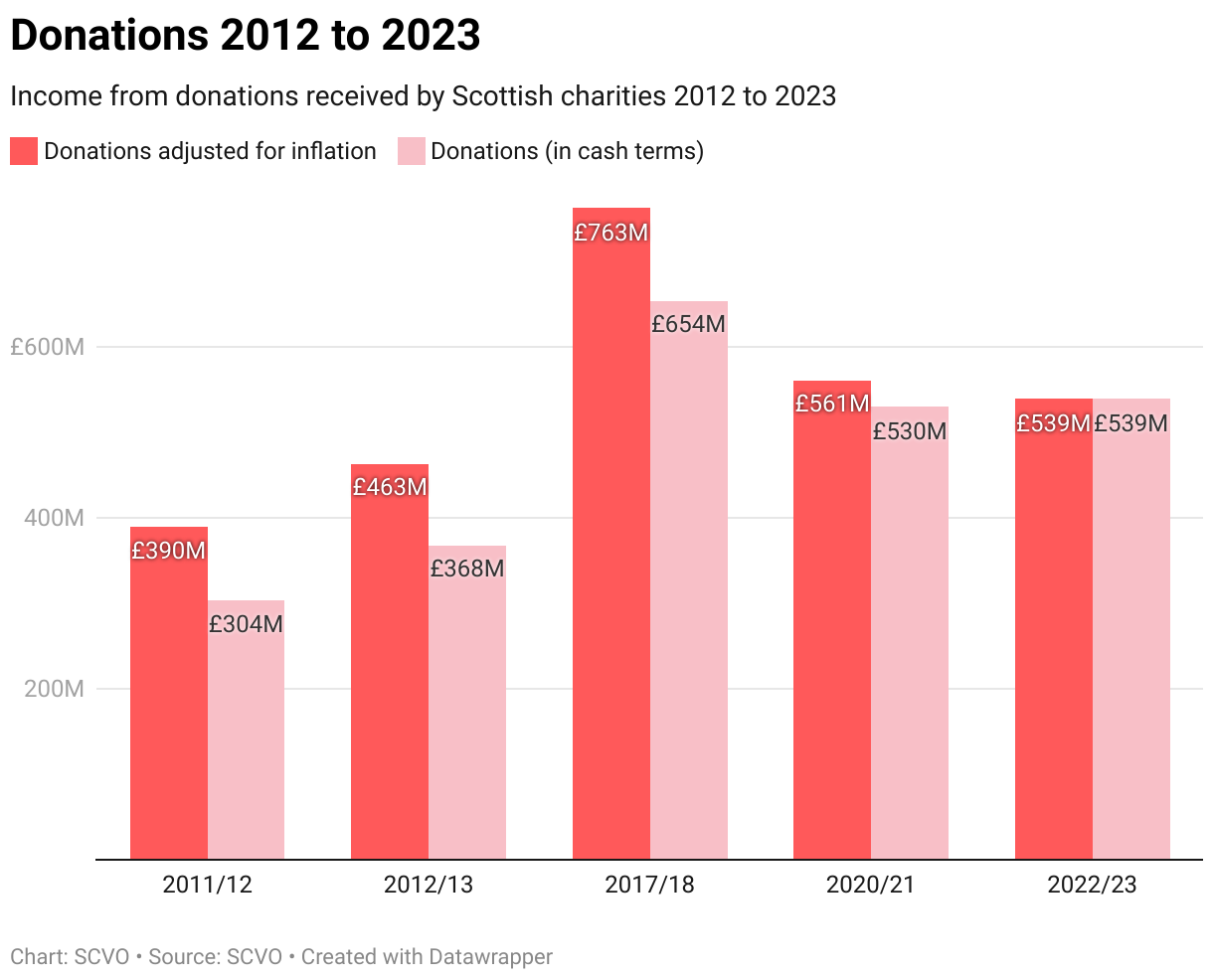
- Donations from individuals contributed £539m to Scottish charities' income in 2023.
- Donations are still the most important source of individual giving for charities, but have decreased in value since 2018, when £654m was received in donations (equivalent to £763m when adjusted for inflation).
- Donations have seen a real terms fall of £224m between 2018 and 2023 - a drop of 30%.
- The picture over a longer time period is more positive: donations increased in real terms by £150m between 2012 and 2023, an increase of around 38%.
- The Covid pandemic had an impact on certain types of giving such as sponsorship and fundraising events and was followed by the cost of living crisis in 2022/23 which had a further impact on donations. These funding streams appear to have recovered to some extent but not fully, and donations remain subdued.
- Note that many donations gifted by individuals in Scotland will go to large UK charities and are not included in the data for Scottish charities.
CAF UK Giving Report 2023The cost of living crisis had an impact on charitable giving in 2022-2023:
"Across 2022, more than two thirds (69%) of people indicated they would need to make cuts to their spending to help manage bills, including 17% who said they would be likely to cut their charitable donations. In total, a quarter (24%) of people reported they had made, or were considering making, changes to their charitable behaviours. This included reducing or cancelling a regular charity donation (5%), and choosing not to make a one-off donation (10%).” (CAF UK Giving Report 2023)
-
Current donations trends reported by organisations - Scottish Third Sector Tracker
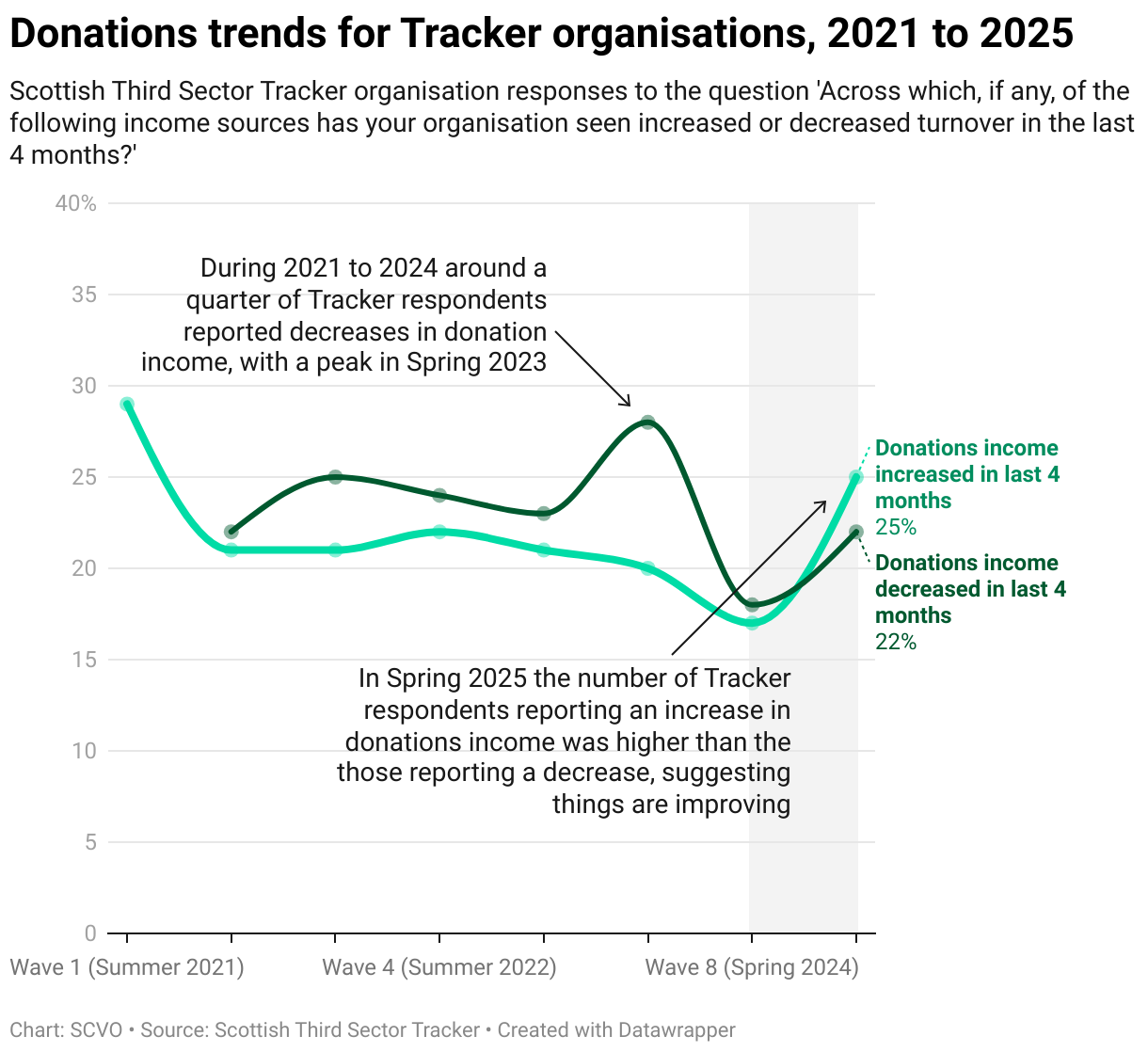
The Scottish Third Sector Tracker asks representatives from Scottish third sector organisations about a range of current topics, including their recent funding sources.
- During 2021 to 2024 around a quarter of Tracker respondents reported decreases in donation income, rising to a 28% peak in Spring 2023.
- Around a fifth of Tracker respondents have been reporting an increase in income from donations since Winter 2021.
- In Spring 2025 the number reporting an increase in donations income rose to 25%, and was higher than those reporting a decrease, suggesting an improvement in donated income.
- In Spring 2025, 24% of Tracker respondents whose organisations had seen an overall increase in turnover said that donations had been the income source that had contributed the most to that increase, up from only 7% in Spring 2023.
- If the experience of Tracker respondents accurately reflects the wider sector then we may well see the levels of donations from individuals increase.
-
Legacies
Remember A Charity and Legacy Foresight"In challenging economic times, legacy income is giving Scottish charities strength and resilience, generating a vital and growing pot of unrestricted funding that can be directed wherever it is most needed. While Scotland’s legacy market is younger than that of England and Wales, it is seeing considerable long-term growth, with hundreds of charities of all shapes and sizes now being named in Wills each year, funding vital services across Scotland when that support is most needed." The Scottish Legacy Market Report 2023
Income from legacies
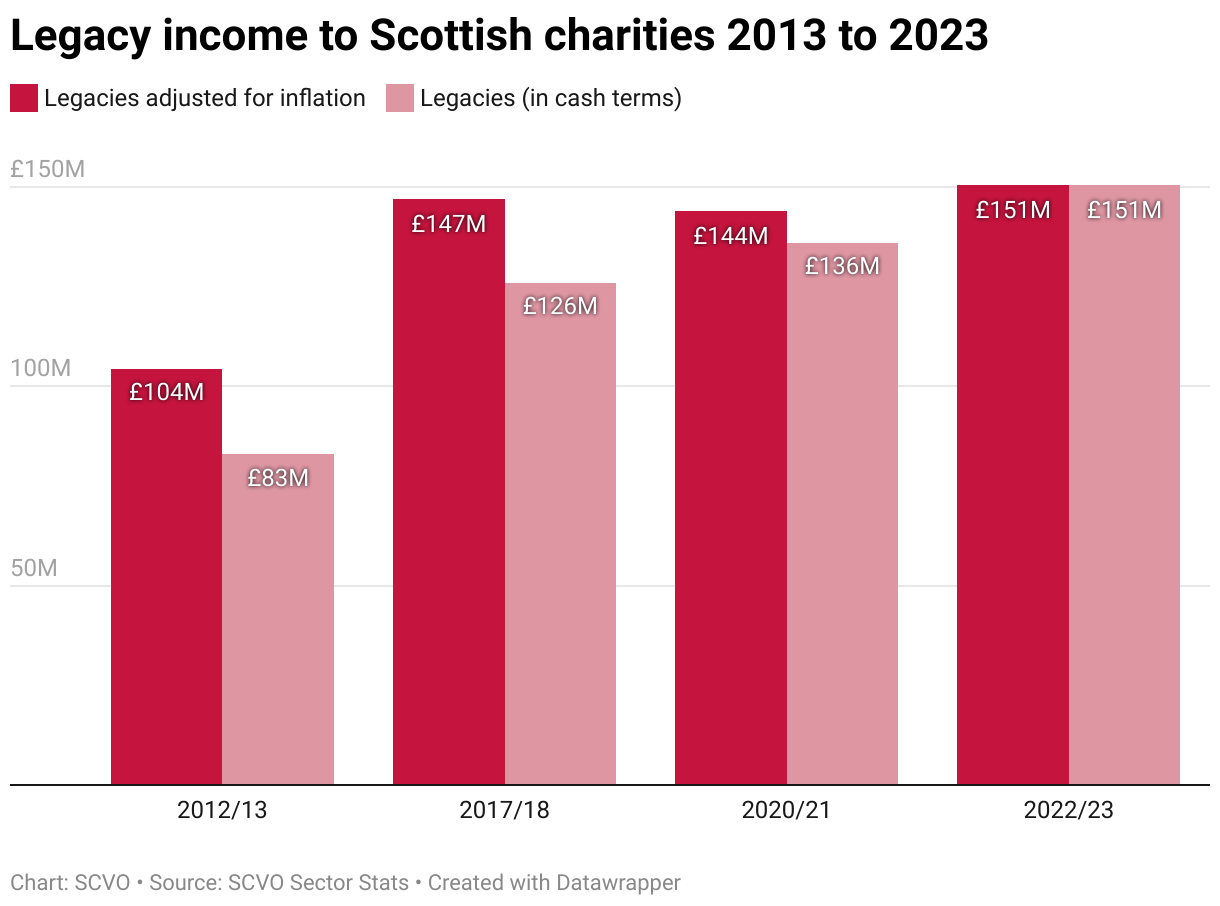
- Legacy income accounts for just over one fifth of all money donated to Scottish charities annually.
- Legacy income to Scottish charities has almost doubled over the last decade, rising from £83m in 2013 to £151m in 2023.
- When we adjust for inflation we can still see real term growth in legacies, but it has flattened in recent years.
- Legacy income has become a crucial source of income for many Scottish charities, and is often unrestricted making it a particularly valuable gift.
- Almost half of all Scottish charities’ legacy income goes to Scotland’s top 50 charities, who received £66m in 2020/21, with the biggest share going to health causes (Scottish Legacy Market Report 2023).
- Note that many legacies gifted by individuals in Scotland will go to large UK charities and are not included in the data for Scottish charities.
-
Fundraising income and trends
Income from fundraising and trading to raise funds
Income from Fundraising and 'Trading to raise funds' sits somewhere between purely voluntary income and purely earned income, as illustrated above. For the purpose of this briefing we are including it under Individual Giving - see the Methodology and key data sources section above.
-
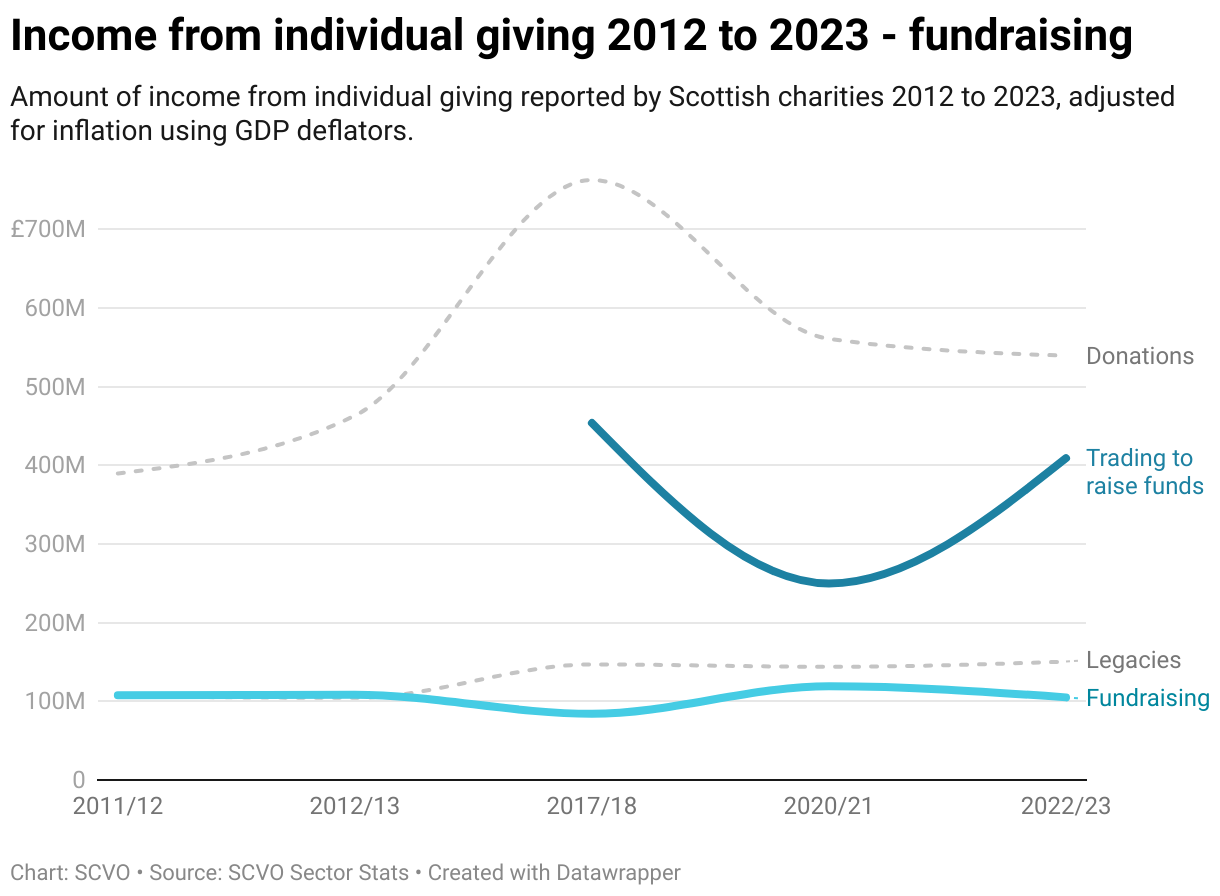
- Fundraising income was worth £105m to Scottish charities in 2023, and has remained fairly stable over the last decade - see chart below.
- Income from 'trading to raise funds' has behaved more erratically in recent years, falling from £454m in 2018 to £250m in 2020/21, reflecting the impact of Covid on charities' commercial activities.
- Income from 'trading to raise funds' rose again to £409m in 2023 - it appears to be making a recovery, although still not back to 2018 levels.
-
Fundraising income trends reported by organisations - Scottish Third Sector Tracker
The Scottish Third Sector Tracker asks representatives from Scottish third sector organisations about a range of current topics, including their recent funding sources.
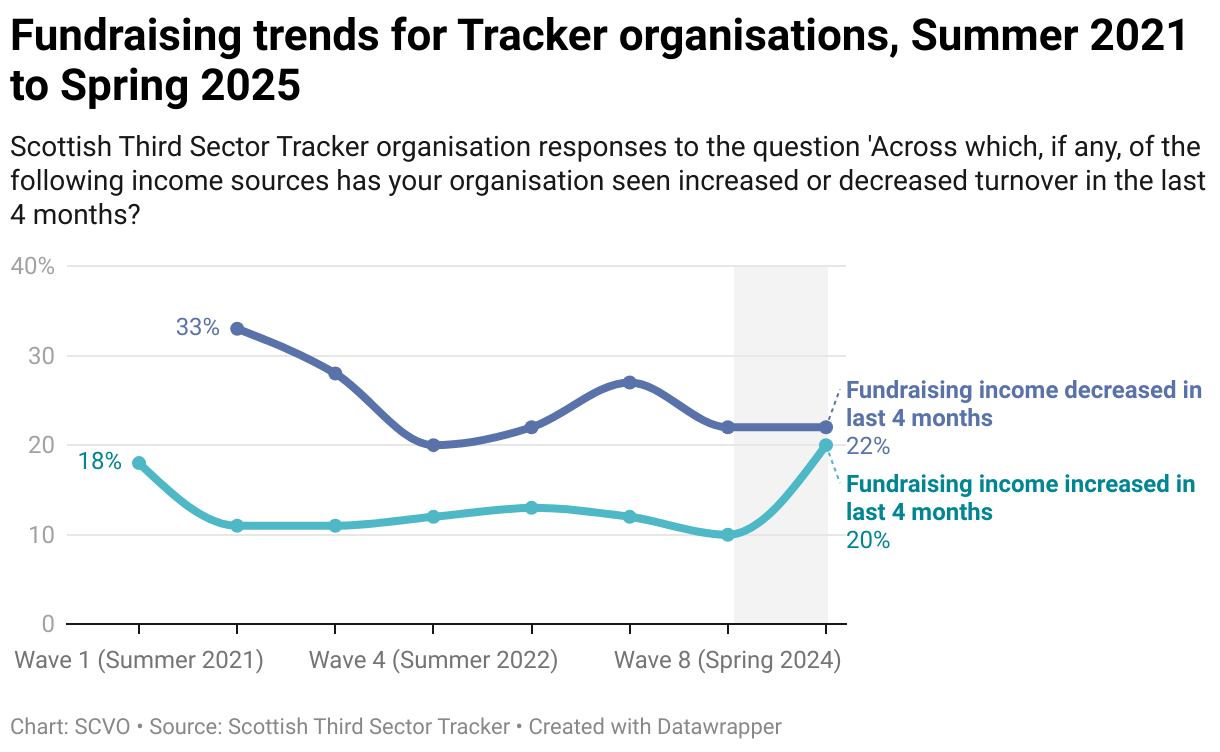
- We can see in the chart below that in Winter 2021 around a third of Tracker respondents reported decreases in fundraising income, although following waves showed an improvement.
- Only around 1 in 10 of Tracker respondents reported an increase in income from fundraising in the previous 4 months in the waves from Winter 2021 to Spring 2024.
- In Spring 2025 the proportion of organisations reporting an increase in fundraising income doubled to 20%, which may be cause for cautious optimism for those charities who rely heavily on fundraising income.
-
Fundraising-related activities on the rise
The sector's main response to recent financial challenges has been to increase fundraising-related activities
- According to the Scottish Third Sector Tracker there has been an increase in fundraising-related actions taken in response to current financial challenges.
- 72% of Tracker respondents reported taking an action related to applying for funding in Spring 2026, up from just 58% in Spring 2025:

-
Breakdown of specific responses to current financial challenges
- The chart below shows that applying to new funders, applying to existing funders for new funding, and developing new income streams including fundraising were the top three most popular responses to financial challenges in Spring 2026 (Scottish Third Sector Tracker).
- Over the past year, we have seen an increase in the number of organisations undertaking fundraising activities, reflecting the increasing need to secure additional sources of income.
- 64% of Tracker respondents in Spring 2026 reported applying for funding from new funders in the previous six months, up from 52% in Spring 2025.
- In Spring 2026, 45% said they had applied for new or additional funding from existing funders in the previous six months, up from 31% in Spring 2025.
- 42% reported they had developed new income streams including fundraising in Spring 2026, up from 21% in Spring 2025.

What do we know about individual donor trends?
Donors in Scotland
- According to CAF's UK Local Giving Report 2026 Scottish people donated an estimated £910m to charities in 2025.
- This is down from an estimated £1.1bn donated to charities by Scottish people in 2024 (CAF UK Local Giving Report 2025 )
- The mean (average) amount donated per month by Scottish donors in 2025 was £50, down from £56 in 2024.
- In 2025, 58% of Scottish people gave financial support to charities via donating to charity or sponsored someone, slightly higher than the UK figure of 55%.
A large proportion of donations gifted by individuals in Scotland will go to large UK charities. According to the latest CAF UK Giving report around a third of donors said they made all, or most, of their donations to national UK-wide charities. Because of this we see a mismatch between the total amount people in Scotland say they have given and the total donations received by Scottish charities.
UK giving trends
2025 saw a reduction in both the number of donors and the average value of donations, resulting in a decrease in total UK giving:
- In 2025 the British public donated an estimated £14 billion - this is a decline from £15.4 billion in 2024 and is the first decrease in total giving since 2021. (CAF's UK Giving Report 2026).
- The fall was driven by a decrease in the average donation amount, which dropped from £72 in 2024 to £65 in 2025.
We have also seen a long-term trend towards fewer people giving to charity. For the second year in a row, just 50% of people donated to charity in the past 12 months (see CAF's UK Giving Report 2026). In the past this decline in the number of people donating was offset by remaining donors giving larger amounts, but last year also saw the average value of donations fall.
- Only half of the UK population (50%) now donates to charity, down from 58% in 2019.
- CAF estimates that around six million fewer people donate to charity than a decade ago - a particularly steep drop occurred during the pandemic, when there was a cumulative loss of nearly four million donors throughout 2020 and 2021.
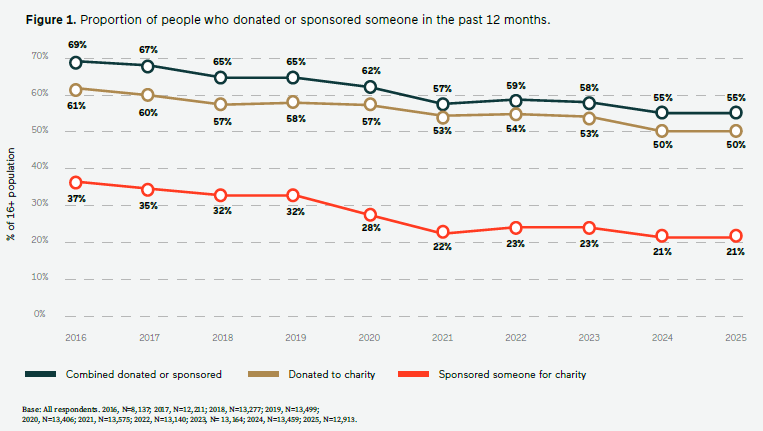
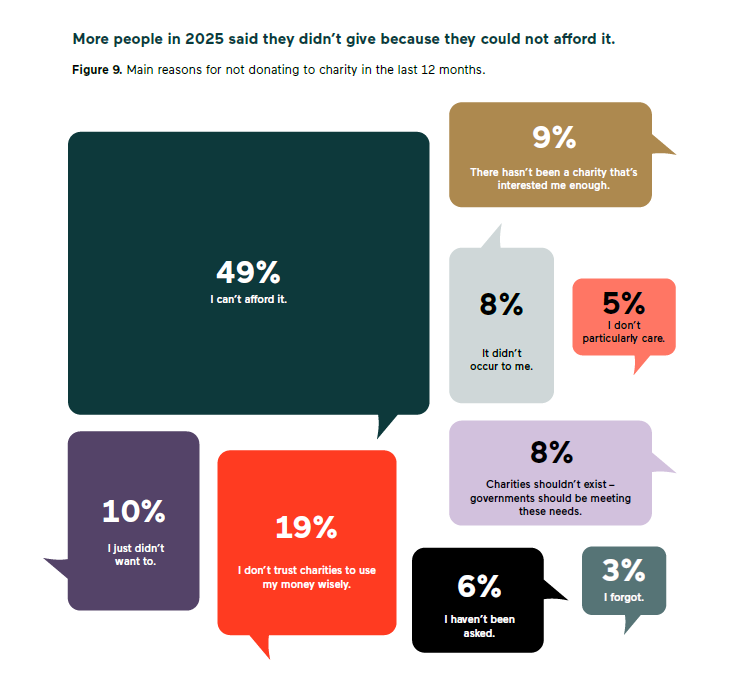
One in five people say they cannot afford to give to charity - lack of affordability was the main reason cited by non-donors (49% in 2025, up from 44% of non-donors in 2024):
UK no longer one of the world’s most generous countries
- The UK has fallen out of the Top 20 most generous countries in the world, and was ranked 22nd in CAF's 2024 World Giving Index
- The UK’s score has fallen in each of the three individual measures: helping a stranger, giving money or volunteering for a good cause.
- More positively the UK continues to rank significantly higher than many other European countries, for example Germany (#37) and France (#100).
Neil Heslop, Chief Executive of CAF"The long-term decline in the UK’s overall generosity shows we seem to have increasingly fallen out of the habit of giving - both our time and our money. Building a giving society is crucial to connect us to one another in communities and strengthen our social fabric. While we can still be a generous country even when times are so tough, more needs to be done to prevent this downward trend from continuing." Charity Aid Foundation 2024
For more on voluntary sector funding and donor trends see:
Thanks for your comment