SCVO Briefing: Strengthening Scotland’s Partnership with the Third Sector
SCVO
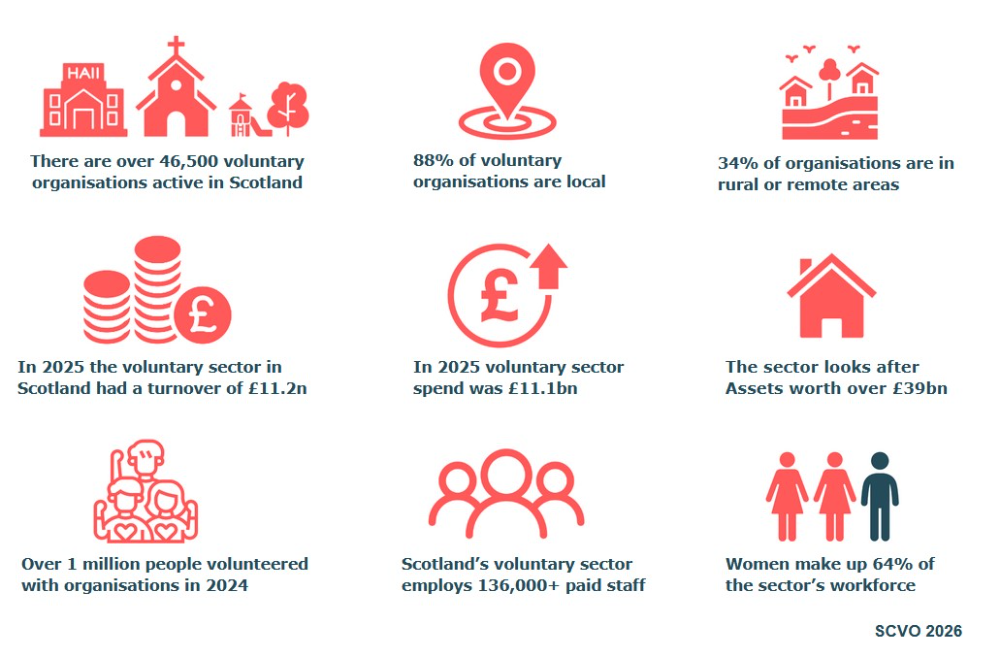
The Scottish Council for Voluntary Organisations (SCVO) is the national membership organisation for the voluntary sector in Scotland.
Our mission is to champion the role of voluntary organisations in building a flourishing society and support them to do work that has a positive impact.
We are passionate about what the voluntary sector can achieve. Along with our community of 3,739 members and supporters, we believe that a thriving voluntary sector should be at the heart of a successful, fair and inclusive Scotland.
Our position
A blueprint for a new partnership between the voluntary sector and the Scottish Government
Ahead of the 2026 Scottish Parliament election, SCVO called for the new Scottish Government, its agencies and bodies, to commit to a new, formalised partnership with the voluntary sector—one that is:
- Underpinned in statute, and aligned with relevant legislation, strategies and action plans, to ensure consistency and longevity across government departments, agencies and public bodies.
- Accountable for delivery across all public bodies, ensuring that commitments made by the Scottish Government to the voluntary sector are consistently implemented at every level, with clear structures in place to monitor progress, share good practice and ensure follow-through.
- Outcomes-focused, with shared goals that prioritise people and communities.
- Protective of the sector’s independence, recognising its unique role, expertise and voice.
- Aligned with Fair Funding principles, by embedding transparent and sustainable funding practices across all public bodies.
Prior to the election, SCVO welcomed the Scottish Government’s commitment to establishing “The Third Sector Partnership”. Now that a new government has been formed, SCVO is calling for work to begin on establishing this new, formalised relationship. As a first step, we are calling for:
- Clear leadership to be established at the centre of government, led by the First Minister, to ensure consistency across all government portfolios, agencies and bodies.
- Meaningful engagement with the voluntary sector to co-design the principles that will underpin the agreement, ensuring the process reflects the diversity of the voluntary sector in Scotland (from large national organisations to small, locally-based ones).
- A clear roadmap for developing and implementing a statutory partnership between the voluntary and public sectors, to be published within the first year of the new parliamentary term.
- A commitment to sustained resourcing to support both the development and implementation of a partnership framework, including capacity within government and the sector to enable meaningful engagement, coordination and delivery.
- Development of clear monitoring, evaluation and accountability mechanisms, to ensure that partnership is implemented effectively, and to deliver consistency across government over time.
WHY IS A FORMAL AGREEMENT NEEDED ?
Voluntary organisations are at the heart of Scotland’s response to the biggest challenges we face — tackling poverty, improving health and wellbeing, supporting children and families, strengthening local economies, advancing climate action, building skills for the future, and much more besides.
The Scottish Government has consistently recognised the importance of effective collaboration between the voluntary and public sectors1.
Despite the instrumental role that the voluntary sector plays in delivering for people and communities, there is no singular experience of engagement with public bodies. Different public bodies have different approaches to engaging with voluntary organisations and even within organisations, approaches vary significantly.
Too often that experience is poor. Evidence on partnership working between the voluntary and public sectors highlights the barriers to collaboration. In 2022, SCVO worked with its members, as well as partners across local and national government, to gather evidence on collaboration and partnership working across sectors2. The findings published across several reports identified four main themes - time, power, trust and value - that underpin relationships between the public and voluntary sectors.
Recent findings from SCVO’s Scottish Third Sector Tracker also highlight organisations’ experiences of weak relationships with public bodies, lack of trust‑based approaches, and insufficient involvement in decision‑making. Participants called for more collaborative partnerships that recognise the voluntary sector’s expertise and essential role in supporting communities.
Historically, Scotland has had more formalised partnership arrangements. The Scottish Compact, agreed between the then Scottish Executive and the third sector in the late 1990s and subsequently refreshed in 2004, is the last time specific guidelines and expectations were set out3. However, the Compact has not been maintained or embedded in practice and no longer provides an effective framework for collaboration.
Scotland is now an outlier in the UK. All other parts of the UK have established formal arrangements to support partnership working between government and the voluntary sector. In Wales, the relationship is underpinned in statute through its Third Sector Scheme. In Northern Ireland, a new partnership agreement was launched in 2025. At UK level, the Civil Society Covenant, introduced in 2025, sets out a new framework for strengthening relationships between government and the voluntary sector. While these models differ in structure and legal basis, they reflect a shared recognition that effective partnership requires clear frameworks, shared expectations and sustained commitment.
In Scotland, a new, equitable partnership is needed to support consistent and effective outcomes and to deliver the best outcomes for people and communities.
As outlined in the Forces for Good report published in 2024, “the potential to drive social change is immense if we can change our understanding of charities and, in so doing, unlock new partnerships around shared missions”4. As the report continues, some of the issues “are quick things to fix, others require deep shifts in mindsets, systems and practice. They require shared spaces; better intelligence; and support to innovate and take risks – all things for which resource is currently critically limited”5. The same could be said about Scotland today and the impact of the voluntary sector on Scottish society and economy.
The political environment is volatile, inequalities are deepening and the climate emergency looms ever larger. Charities, social enterprises and community organisations have never been more needed, yet they have never been more under pressure. However, while there are many challenges facing us all today, there are also many opportunities for innovation, investment and partnership working, but we need action, not more words and strategies.
The new government and the commitment to a partnership agreement with the voluntary sector in Scotland is a chance to start the shift in mindsets that is needed to ensure that, in five years’ time, voluntary organisations are not still fighting to be treated fairly. The risk otherwise is a country where slow economic growth, entrenched inequalities, and the impact of the climate crisis have become the norm, compounded by a continued failure to acknowledge and value the role of the voluntary sector.
That must be avoided. That is why the Third Sector Partnership must be developed collaboratively, transparently and with urgency so that the people and the communities we all support can realise its benefits.
1 See, for example, Renewing Scotland’s public services: priorities for reform in response to the Christie Commission (2011); the Public Service Reform Strategy (2025) and Democracy Matters: a route map to reform (2026).
2 Scottish Government funding of voluntary organisations: a case study of voluntary sector intermediaries: In October 2022, SCVO published a report on the experiences of voluntary sector intermediaries to shine a light on how the Scottish Government directly funds voluntary organisations, including the processes it adopts and how it interacts with those that receive funding.
Supporting collaboration between the third and public sectors: evidence review: The research review conducted in 2022 as part of the Strengthening Collaboration work between Scottish Government, SCVO, COSLA and the TSI Network has found that issues of trust, power and structure are as prevalent as ever.
Organisational profiles: funding and public sector relationships: in 2021 SCVO commissioned an independent consultant, Arrivo Consulting, to conduct depth interviews with several of our members. The aim of the project was to deepen our understanding of the key challenges faced by third sector organisations, specifically in relation to funding and relationships with the public sector.
3 “Compact in action: Compact woes in Scotland”, Third Force News (2007)
4 p.25
5 p.25
Contact
Rachel Le Noan
Policy & Public Affairs Officer, SCVO
Rachel.lenoan@scvo.scot